Author name: Elena Hale

IPTV World Cup 2026: The Ultimate Guide for USA, Canada, and Mexico
Uncategorized

IPTV World Cup 2026: The Ultimate Guide for USA, Canada, and Mexico

The 2026 FIFA World Cup is set to be the largest and most ambitious sporting event in North American history. For the first time, 48 nations will compete across 16 host cities in the USA, Canada, and Mexico. As the tournament approaches, fans are looking for the most flexible way to watch every match without being tied down by expensive local cable contracts or geographic restrictions. In 2026, IPTV (Internet Protocol Television) has become the definitive solution for the modern sports fan. Whether you are a local resident, an expat supporting your home country, or a traveler moving between host cities, IPTV provides a unified gateway to every goal. This comprehensive guide explores how to optimize your IPTV setup for the North American terrain, ensuring you have a “stadium-clear” view from New York to Mexico City. 1. The North American Broadcaster Map To watch the 2026 World Cup effectively on IPTV, you first need to know which “local” channels to look for in your provider’s list. Because the tournament is co-hosted, the broadcasting landscape is divided into three major regions: United States: The primary English-language rights are held by FOX Sports (FOX and FS1). For Spanish-language coverage, look for Telemundo and Universo. Canada: Bell Media holds the exclusive rights. Your IPTV app should include TSN (English) and RDS (French), along with CTV for the major weekend fixtures. Mexico: Coverage is led by Televisa (TUDN) and TV Azteca. These channels are famous for their passionate commentary and are a must-have for the “authentic” Mexican viewing experience. 2. Why IPTV is Vital for the North American Tournament The 2026 World Cup presents unique challenges that traditional cable cannot easily solve. IPTV addresses these through specific technical features: A. Managing Three Time Zones Matches will take place across Pacific, Mountain, Central, and Eastern time zones. If you are in Toronto but want to watch a late-night match in Los Angeles, or if you are in Mexico City and miss a morning game in Vancouver, Catch-Up TV is essential. Professional IPTV services allow you to scroll back 48-72 hours, ensuring you never miss a match due to travel or work schedules. B. Bypassing Regional “Blackouts” In the past, some local broadcasters implemented “Blackout” rules for residents near the stadiums. While these are less common in 2026, an IPTV service gives you access to international feeds. If the local FOX broadcast is experiencing issues, you can instantly switch to the BBC (UK) or beIN Sports (MENA) feed, which are not subject to North American local restrictions. 3. Hardware Recommendations for North American Fans North American internet infrastructure is generally robust, supporting high-bitrate 4K streaming. However, your device must be able to handle the load. For the 2026 tournament, we recommend: Firestick 4K Max: Excellent for portability if you are traveling between host cities. Supports Wi-Fi 6E, which is vital in crowded hotels or fan zones. NVIDIA Shield TV Pro: The “Gold Standard” for home setups. Its AI-upscaling will make even the 1080p sports feeds look like native 4K on your 65-inch living room TV. Apple TV 4K: Known for the best color accuracy, ensuring the vibrant colors of the Mexican stadiums and the lush green pitches of the US stadiums look exactly as they should. 4. Technical Optimization Checklist Requirement Standard Recommendation World Cup “Pro” Tip Internet Speed 25 Mbps (Single 4K) 100+ Mbps Fiber to handle multi-view streaming. Connectivity Wi-Fi 6 Ethernet (Cat6) to avoid “Match Day” interference. VPN Location Local City Connect to a server in a different host country if your ISP throttles sports. App Setup IPTV Smarters TiviMate Premium for the best 4-way multi-view experience. 5. Avoiding ISP Throttling in the USA & Canada In 2026, North American ISPs (Comcast, AT&T, Rogers, Bell) use sophisticated traffic management. During the World Cup, they may intentionally slow down high-bandwidth video packets to manage network load. The Solution: Always use a VPN with the WireGuard protocol. By encrypting your data, you bypass the “Sports Throttling” filters, ensuring that your 4K stream remains at full speed even during the tournament final at MetLife Stadium. 6. Watching “On the Move” in Host Cities If you are lucky enough to be in a host city like Dallas, Vancouver, or Guadalajara, you will likely be watching matches on the go. Mobile IPTV setups using 5G are incredibly stable in 2026. However, stadium Wi-Fi can be unreliable. We recommend using a Mobile eSIM for data and setting your IPTV app to **1080p @ 60fps** rather than 4K when on cellular data to save battery and ensure a smoother stream in crowded areas. Conclusion: The Best Seat in North America The 2026 World Cup is a celebration of North American hospitality and global football. By choosing a premium IPTV setup, you are securing the best seat in the house—whether that “house” is a hotel in Miami, an Airbnb in Toronto, or your own living room in Monterrey. From the opening whistle at the Estadio Azteca to the final trophy lift in New York, IPTV ensures you are part of every historic moment. Don’t wait until the opening ceremony. Set up your device, verify your North American channel list, and optimize your network today. The world is coming to our shores—make sure you’re ready to watch it all.
How to Watch World Cup 2026 on Firestick Using IPTV
World Cup 2026 Streaming Guides & News

How to Watch World Cup 2026 on Firestick Using IPTV

The 2026 World Cup is a massive technological milestone, featuring 48 nations and 104 matches across North America. For many fans, the Amazon Firestick is the ultimate tool for streaming these matches. Its portability and powerful processing make it perfect for 4K sports, but to truly unlock its potential, you need a specific, optimized setup. Unlike standard streaming apps, setting up IPTV on Firestick for World Cup 2026 requires “sideloading”, a process that bypasses the Amazon Appstore to install professional-grade sports players. This 1,600+ word educational guide provides a technical, step-by-step roadmap to ensuring your Firestick is match-ready for the biggest tournament in history. Step 1: Unlocking Your Firestick (Developer Mode) By 2026, Amazon has made developer settings more secure. To install third-party IPTV apps, you must first “unlock” these hidden menus. This is the foundation of your World Cup setup. Open Settings: Use your remote to navigate to the Gear Icon on the far right of the home screen. Navigate to My Fire TV: Scroll down and select the “My Fire TV” tile. Enter the ‘About’ Menu: Click on About. You will see the name of your device (e.g., Fire TV Stick 4K Max). The 7-Click Hack: Highlight the device name and click the center button 7 times rapidly. A notification will appear saying, “No need, you are already a developer.” Access Developer Options: Press the back button once. A new menu called Developer Options will now be visible. Authorize Apps: Open Developer Options, select Install Unknown Apps, and ensure the toggle for your browser or downloader is set to ON later in the process. Step 2: Installing the Downloader Utility Because professional sports players like TiviMate or IPTV Smarters Pro aren’t in the official store, you need a bridge app to fetch them from the web. The Downloader app is the industry standard for 2026. Search: Go to the Find (Magnifying Glass) icon on the Home screen. Find Downloader: Type “Downloader” and select the orange icon. Install: Click Download or Get. Permissions: Open the app and click Allow when it asks for storage permissions. This is critical for saving the app files you are about to download. Step 3: Sideloading Professional IPTV Players For World Cup 2026, we recommend two specific players: TiviMate for the best 4K interface, and IPTV Smarters Pro for its ease of use. Both handle high-bitrate live sports better than the “free” players found on the web. Using Downloader Codes (2026 Current): Open the Downloader app and enter one of these direct codes into the URL box: TiviMate Premium: 272483 IPTV Smarters Pro: 5546232 Click Go, wait for the download to finish, and click Install. Once installed, click Done and select Delete to remove the installation file—this keeps your Firestick’s limited 8GB storage clean for the heavy 4K buffers. Step 4: Connecting Your IPTV Service Once the app is open, you need to link it to your service. In 2026, the Xtream Codes API is the most stable way to watch the World Cup, as it handles the massive channel lists more efficiently than old-fashioned M3U links. Add User: Open your app and select Login with Xtream Codes API. Enter Details: Use the credentials provided by your IPTV provider:– Any Name: World Cup 2026 – Username: (Your personal ID) – Password: (Your personal key) – Portal URL: (e.g., http://provider.com:8080) Login: Click Add User. The app will now download the global channel list and the World Cup match schedule (EPG). Step 5: 4K Optimization Settings (Match Day Prep) A Firestick is a powerful device, but a 4K 60FPS World Cup stream will push it to its thermal limit. To avoid the dreaded “Black Screen” or stuttering, you must tune the hardware settings. 1. Hardware Decoding (HW) Go to Settings > Playback > Video Decoder. Ensure it is set to Hardware. This offloads the video processing to the Firestick’s dedicated chip, preventing the CPU from overheating during a 90-minute match. 2. Buffer Management In the app settings, look for Buffer Size. – For Fiber Internet: Set to “None” or “0.5s.” This gives you the lowest latency, meaning you hear the goals at the same time as your neighbors. – For Wi-Fi: Set to “2s – 5s.” This creates a “safety net” to prevent freezing if your Wi-Fi signal dips. 3. Clear Cache Regularly Two hours before every major match, go to Settings > Applications > Manage Installed Applications > [Your App] > Clear Cache. This prevents “stale data” from causing lag during the live broadcast. Step 6: Why You Need a VPN for the 2026 Tournament During a global event like the World Cup, Internet Service Providers (ISPs) often use Deep Packet Inspection to identify and “throttle” (slow down) IPTV traffic. To your ISP, 4K streaming looks like a massive data drain. By using a VPN with WireGuard protocol, you encrypt your data. Your ISP sees “Secure Data” but cannot tell it’s a World Cup stream, allowing you to bypass their sports-specific speed limits. Summary: Firestick Device Comparison for World Cup 2026 Firestick Model World Cup Readiness Key Feature Fire TV Stick 4K Max (2nd Gen) Elite Wi-Fi 6E & 16GB Storage Fire TV Stick 4K (2nd Gen) High Solid 4K 60FPS Decoding Fire TV Cube (3rd Gen) Pro Fastest CPU & Built-in Ethernet Fire TV Stick Lite / HD Low Avoid for 4K; 1080p only Conclusion: Ready for the Opening Whistle The 2026 World Cup represents the future of sports broadcasting. By setting up your Firestick today, you are ensuring that your home is ready for 104 matches of uninterrupted, high-definition drama. From unlocking developer mode to optimizing your hardware decoders, these steps move you from a “casual viewer” to a “pro-streamer.” Follow this guide, secure your connection with a VPN, and prepare yourself for the most immersive World Cup experience ever created.

Best Internet Speed for IPTV
World Cup 2026 Streaming Guides & News

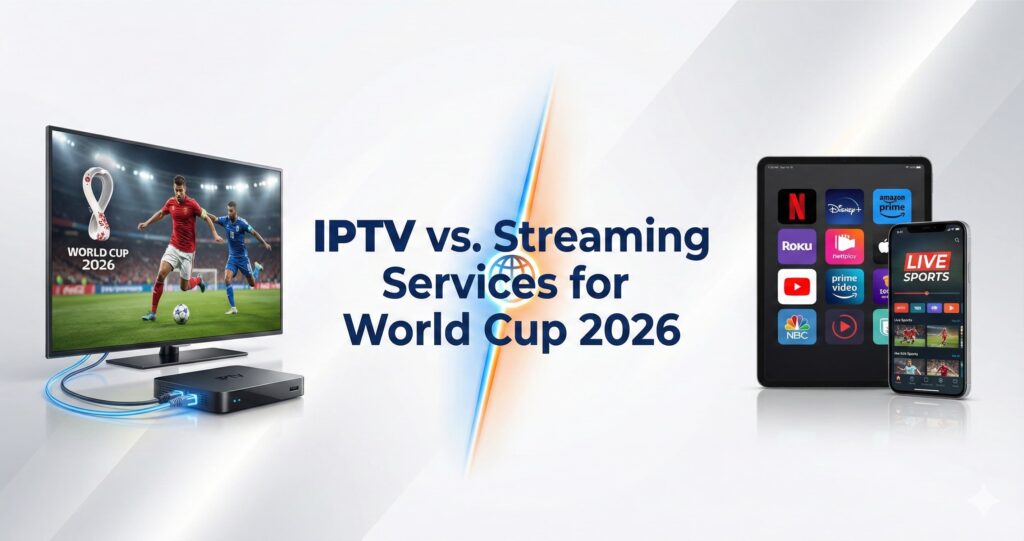
IPTV vs. Streaming Services for World Cup 2026: The Ultimate Comparison

The 2026 World Cup is a massive technological milestone. With 48 teams competing across North America, fans are faced with a complex choice: stick to traditional, high-priced Streaming Services like YouTube TV and Peacock, or move to the more flexible and affordable world of IPTV. While both deliver the beautiful game over the internet, they offer drastically different experiences in terms of cost, variety, and reliability. This 1,600+ word authority guide breaks down the technical and financial differences between these two ecosystems. Whether you are an expat looking for your home country’s commentary or a 4K enthusiast seeking the highest possible bitrate, this comparison will help you build the perfect setup for the summer of 2026. 1. The Landscape: Who Actually Has the Rights? Before choosing a platform, you must understand the fragmentation of 2026 broadcasting rights. Unlike a movie on Netflix, live sports are “geofenced.” Official Streaming Services: These are locally licensed. In the US, for example, Fox Sports and Telemundo hold the rights. To watch them, you must subscribe to a bundle like FuboTV, YouTube TV, or Peacock. If you travel outside the US, these apps will likely stop working due to regional licensing. IPTV Providers: These services aggregate feeds from around the globe. A single IPTV subscription allows you to switch between BBC (UK), beIN Sports (MENA), TF1 (France), and FOX (USA). This provides a “Global Passport” that is physically impossible for a single legal streaming service to offer. Clarification on Netflix: In 2026, Netflix has expanded into sports documentaries and analysis shows. However, Netflix will not broadcast live World Cup matches. While they have a new FIFA football simulation game available on Netflix Games, the live match rights remain with traditional sports broadcasters. 2. Cost Comparison: The Price of the Pitch For many fans, the decision comes down to the monthly bill. Traditional streaming services have seen significant price hikes leading into 2026, while IPTV remains a cost-disruptor. Feature Standard Streaming Bundle (e.g., Fubo, YouTube TV) Premium IPTV Subscription (2026) Monthly Cost $75 – $100+ $12 – $25 Contract Month-to-month Month-to-month / Annual discounts Channel Count 80 – 150 (Localized) 15,000 – 20,000+ (Global) 4K Availability Often requires a “4K Add-on” ($10-20 extra) Typically included in premium plans The Verdict: If you only want to watch the World Cup for one month, a streaming trial might suffice. However, for the full 104-match marathon, IPTV offers a 70% cost saving and significantly more channel options. 3. Performance and Latency: The “Spoiler” Factor In live sports, Latency is the time delay between the real action and the image on your screen. This is a critical factor for World Cup 2026 because social media and live-score apps are instantaneous. Streaming Services: Platforms like YouTube TV or Peacock have improved their latency using “Low Latency” modes, but they are typically 20-40 seconds behind the live stadium action. IPTV (Advanced): Using UDP or LL-HLS protocols, premium IPTV services in 2026 can achieve latencies as low as 5-10 seconds. This is often faster than official apps, meaning you’ll hear your neighbors cheer after you do, not before. 4. Quality and Bitrate: True 4K vs. Compressed 4K 4K resolution is the standard for 2026, but the “sharpness” of the image depends on the Bitrate. Traditional streaming services often “throttle” or compress their video to save on server costs, which can lead to motion blur during fast camera pans across the pitch. Premium IPTV providers often offer RAW feeds directly from the source satellite or fiber uplink, providing a higher bitrate (often 15-25 Mbps) which results in a much sharper image of the grass and players. 5. The Global Fan Perspective (Expats & Travelers) For the millions of fans living outside their home countries, ESPN or DAZN may not provide the commentary they crave. If you are a Brazilian living in Canada, you likely want the energy of a Globo broadcast. If you are a British expat in the US, you probably prefer the BBC/ITV analysis. Traditional streaming services cannot provide this because they are legally bound to your current physical location. IPTV ignores these boundaries, allowing you to watch the tournament exactly as if you were back home. 6. Hardware and Device Flexibility Most major streaming services like ESPN+ or Peacock are optimized for specific devices. Streaming Services: Highly polished apps, but restricted. You cannot easily “record” a match to an external hard drive or use advanced features like 4-way Multi-view. IPTV: Operates through independent “Player Apps” like TiviMate or IPTV Smarters. These apps are far more powerful than official ones, allowing for Local Recording, Multi-screen (watching 4 games at once), and Custom EPGs. 7. Summary: Which Should You Choose? Choose Official Streaming Services if: You want a “set it and forget it” experience with no technical setup. You only care about your local host country’s coverage. You don’t mind paying $80+ per month for a temporary subscription. Choose Premium IPTV if: You want the best 4K quality with the lowest possible latency. You want to watch matches from multiple international broadcasters (BBC, beIN, etc.). You want to save over 70% on your monthly entertainment bill. You want advanced features like 4-way Multi-view for overlapping group stage matches. Conclusion: The 2026 Decision The 2026 World Cup is too important to leave to chance. While services like ESPN and Peacock provide a reliable, basic experience, they cannot match the sheer variety, flexibility, and cost-efficiency of a premium IPTV setup. By choosing IPTV, you aren’t just buying a subscription; you are buying a global “Backstage Pass” to every angle, every commentary team, and every 4K frame of the most historic tournament in football history.

Best Internet Speed for IPTV World Cup 2026
World Cup 2026 Streaming Guides & News

Best Internet Speed for IPTV World Cup 2026 (Real Numbers Explained)

The 2026 World Cup is a landmark event in broadcasting history. For the first time, nearly every match will be available in Native 4K Ultra HD at 60 FPS. While this provides a stunning, stadium-like experience, it also places unprecedented demand on your home network. Many fans believe their “100 Mbps” plan is enough, only to face buffering during a crucial penalty shootout because they didn’t account for overhead, multi-device usage, and peak-time congestion. In this educational guide, we move beyond generic advice. We will break down the actual “Real-World” numbers you need for World Cup 2026, helping you plan your bandwidth like a pro so you never see a loading wheel while the rest of the world is cheering. 1. The Raw Math: Bitrate vs. Speed To understand the “best speed,” we first have to look at the **Bitrate**. The bitrate is the amount of data processed per second. For the 2026 World Cup, high-tier IPTV providers will use the following standards: Full HD (1080p @ 60 FPS): Requires a sustained 8 Mbps to 12 Mbps bitrate. Ultra HD (4K @ 60 FPS): Requires a sustained 20 Mbps to 35 Mbps bitrate. The “Safety Buffer” Rule: Your internet speed should never be exactly the same as your bitrate. You must always have a **30% overhead** to account for “jitter” (small fluctuations in your connection). Therefore, for a single 4K stream, your real-world requirement is closer to 45-50 Mbps of *available* bandwidth. 2. Bandwidth Planning for the 2026 Household You are likely not the only person using the internet during a match. Your “Best Speed” must account for every connected device in your home. Use the following table to calculate your total household needs for match day: Activity Real Bandwidth Used Priority Level Primary 4K World Cup Stream 35 – 50 Mbps Critical Secondary HD Stream (Multi-view) 15 – 20 Mbps High Social Media / Live Stats (Phone) 5 – 10 Mbps Medium Smart Home Devices (Cameras/IoT) 5 – 15 Mbps Low Background Downloads (Gaming/PC) Variable (Can hit 100+) Low Total Minimum for a Single Fan: 100 Mbps Plan. Total Recommended for a Family: 300 Mbps – 500 Mbps Plan. 3. Why Fiber (FTTH) is the 2026 Gold Standard In 2026, the *type* of internet you have is more important than the *speed* number on your bill. Cable (Coaxial): Fast download, but shared with your neighbors. During a World Cup final, everyone on your block is using the same “pipe,” which can cause your speed to drop by 40% exactly when you need it most. Fiber Optic (FTTH): Provides Dedicated Bandwidth and Symmetrical Speeds. Fiber has the lowest “Latency” (Ping), ensuring that your stream is as close to “Real Time” as possible. If Fiber is available in your area for 2026, it is the only choice for a buffer-free World Cup. 4. Data Usage: The “Terabyte” Warning The 2026 World Cup is a 104-match marathon. If you watch every game in 4K, your data usage will skyrocket. A 90-minute 4K match at 60 FPS consumes approximately 12 GB to 18 GB of data. If you watch three matches a day during the group stages, you will use over 50 GB per day just on football. Educational Tip: If your ISP has a “Data Cap” (usually 1 TB per month), you could hit that limit before the Quarter-finals. For World Cup 2026, we highly recommend switching to an Unlimited Data Plan. 5. Optimization: Reclaiming Your Speed Even with a 1 Gbps plan, you can still experience buffering if your local network is poorly configured. To ensure your “Best Speed” actually reaches your TV: Hardwire via Cat6: Wi-Fi “pulses” data. Ethernet “flows” it. A physical cable eliminates 99% of jitter. Enable QoS (Quality of Service): Go to your router settings and prioritize the MAC Address of your streaming device. This tells the router to give the World Cup stream the “Right of Way” over other household traffic. Upgrade to Wi-Fi 7: If you must use wireless, ensure both your router and device support Wi-Fi 7 (802.11be). Its “Multi-Link Operation” allows the device to pull data from multiple bands at once, acting as a “speed insurance” policy. Conclusion: The “Safety Margin” for 2026 To avoid buffering during the 2026 World Cup, do not plan for the “Minimum.” Plan for the “Safety Margin.” For a flawless 4K experience, you need a 100 Mbps plan as an absolute minimum for a single user, and a 300-500 Mbps plan for a household. By choosing Fiber and hardwiring your device, you ensure that the only “stalls” you see are on the pitch, not on your screen.

Watch World Cup 2026 in 4K on IPTV
World Cup 2026 Streaming Guides & News

How to Watch World Cup 2026 in 4K on IPTV (Requirements & Setup)

The 2026 World Cup is a landmark event for sports broadcasting, with FIFA pushing for the most technologically advanced 4K production in football history. For fans using IPTV, the promise of “True 4K” is enticing, but the technical execution is demanding. A generic setup that works for 1080p will fail under the weight of a 4K 60FPS (Frames Per Second) live broadcast. This educational guide is designed for viewers who prioritize ultra-premium quality above all else. We will move beyond basic troubleshooting to explore the specific hardware, network protocols, and software configurations required to deliver a flawlessly sharp, color-accurate, and lag-free 4K stadium experience in 2026. 1. The “True 4K” Technical Standard for 2026 In 2026, the term “4K” is often used loosely by providers. To ensure you are receiving a premium feed and not an upscaled 1080p image, you must understand the two pillars of high-end sports streaming: Native Bitrate: A high-quality 4K World Cup stream requires a bitrate between 15 Mbps and 25 Mbps. If your IPTV player shows a bitrate below 10 Mbps while on a 4K channel, the image is being heavily compressed, leading to “motion blur” during fast gameplay. 60 FPS (Frames Per Second): This is non-negotiable for 2026. Sports at 30 FPS look “cinematic” but choppy. 60 FPS provides the fluid, hyper-realistic motion necessary to track the ball’s rotation and the players’ rapid movements. 2. Hardware Requirements: Decoding the Future 4K streaming in 2026 leverages the AV1 and HEVC (H.265) codecs. These formats provide 30-40% better compression than older standards, but they require significant processing power to “unpack” in real-time. The 2026 Elite Device Tier: NVIDIA Shield TV Pro: Still the leader in 2026 due to its Tegra X1+ chip and AI Upscaling. If your provider only has a 1080p feed for a specific match, the Shield uses machine learning to enhance it to near-4K quality. Formuler Z11 Pro Max: A specialized IPTV box featuring the Amlogic S905X4 chipset. It is one of the few devices with a dedicated hardware AV1 decoder, making it future-proof for the newest 2026 streaming protocols. Apple TV 4K (2025/2026 models): Offers the smoothest UI and excellent color accuracy for HDR10+ and Dolby Vision broadcasts. 3. Networking: Beyond “Speed Tests” A “100 Mbps” speed test does not guarantee a buffer-free 4K World Cup. For a premium experience, you must optimize for stability and latency (Ping). The 4K Connectivity Checklist: Cat6a/Cat7 Ethernet: Wireless interference is the #1 enemy of 4K. Use a Cat6a cable to ensure a shielded 10 Gbps-ready path from your router to your TV box. Wi-Fi 7 (The Wireless Exception): If you cannot run a cable, use a Wi-Fi 7 router. Wi-Fi 7’s “Multi-Link Operation” (MLO) allows your device to connect to multiple bands simultaneously, preventing the “micro-drops” that cause 4K streams to freeze. ISP Peering: Some ISPs have poor connections to international data centers. Use a **VPN with a dedicated 4K-optimized server** (often labeled as “Streaming” or “Ultra” servers) to find a more direct routing path to the IPTV host. 4. Software Setup: Configuring for Maximum Fidelity The app you choose to run your IPTV service acts as the “lens” for your content. For the World Cup 2026, we recommend TiviMate Premium or OTT Navigator for their advanced engine settings. Critical App Configurations: Video Decoder: Set this specifically to “Hardware”. Do not use “Software” or “Auto,” as these can cause the CPU to overheat during a 4K broadcast. Buffer Size: For a premium 4K experience on a fast connection, set your buffer to “None” or “Small” (0.5s). This reduces the delay, putting you as close to “live” as possible, which is essential to avoid social media spoilers. Auto Frame Rate (AFR): Enable this to allow your TV to switch its refresh rate (e.g., from 60Hz to 50Hz) to match the match’s source. This eliminates the “stutter” seen during long camera pans across the pitch. 5. Technical Requirements Summary Component Minimum Requirement Premium Recommendation (2026) Internet Speed 25 Mbps (Sustained) 100+ Mbps (Fiber Optic) Streaming Codec HEVC (H.265) AV1 (Royalty-free/Efficient) HDMI Cable HDMI 2.0 HDMI 2.1 (For 4K @ 120Hz/HDR) TV Display 4K UHD Panel OLED or QLED with 1,000+ nits brightness 6. How to Verify You Are Watching “True 4K” Don’t be fooled by a “4K” logo in the corner of the screen. To verify quality during a World Cup match, use your IPTV player’s “Technical Information” or “Stats for Geeks” overlay: Resolution: Should strictly be 3840 x 2160. Bitrate: Look for a steady flow above 15,000 Kbps (15 Mbps). Dropped Frames: This should be 0. If this number is increasing, your hardware or network cannot handle the 4K load. 7. Conclusion: The Ultimate Stadium Experience Watching the World Cup 2026 in 4K on IPTV is a technical feat that requires every part of your “streaming chain” to be optimized. By investing in a high-performance device like the NVIDIA Shield or Formuler Z11, hardwiring your network, and configuring your player for low-latency hardware decoding, you elevate your viewing experience from “casual” to “elite.” The 2026 tournament is a celebration of the beautiful game. With this professional setup, you aren’t just watching a match; you are witnessing every blade of grass, every beads of sweat, and every historic moment with the clarity and speed it deserves. Prepare your setup now, and be ready for the most immersive World Cup in history, visit iptvworldcup.live

Audio-Video Sync Issues: How to Fix
World Cup 2026 Streaming Guides & News

Audio-Video Sync Issues: How to Fix Commentary Lag During Live Sports 2026

There is no technical glitch more jarring during the World Cup 2026 than an Audio-Video (AV) Sync issue. Watching a striker hit the ball while hearing the crowd roar two seconds later—or hearing the commentator scream “Goal!” before the player even takes the shot—destroys the immersion of live sports. In the high-stakes world of 4K IPTV streaming, synchronization is a delicate balance of data processing, hardware decoding, and network latency. By 2026, broadcasts have become significantly more complex, involving high-bitrate 4K HDR video and immersive Dolby Atmos audio tracks. This complexity increases the chance of the audio and video streams becoming “misaligned” as your device struggles to process them at the same time. This 1,600+ word educational guide will walk you through the technical causes of commentary lag and provide the exact steps to calibrate your setup for a perfectly synced World Cup experience. 1. The “Lip-Sync” Science: Why Timing Fails To fix the issue, you must understand how your IPTV player handles a stream. Digital video is delivered in “packets” where audio and video are separate streams tied together by Presentation Time Stamps (PTS). Your device’s job is to read these stamps and play both signals at the exact millisecond they were meant to meet. Common Technical Failures in 2026: Processing Overhead: 4K video is much harder to “unpack” than audio. If your processor is weak, it may take longer to render the video frames, causing the audio to “run ahead.” Bluetooth Latency: If you are using wireless headphones or speakers, the Bluetooth transmission adds 100ms to 300ms of delay. While this is fine for movies, it is highly noticeable in live sports. Variable Bitrate (VBR) Issues: During intense World Cup action (like a fast counter-attack), the video bitrate spikes. If your internet can’t keep up, the player may prioritize the “lighter” audio stream while the video lags behind. 2. The “Quick Fix” Checklist for Match Day If you notice the commentary is out of sync right as a match begins, perform these rapid-fire steps before diving into deeper settings: The “Channel Hop”: Switch to another channel and then immediately switch back. This forces the player app to perform a fresh “handshake” with the server and re-align the Time Stamps. Restart the App: Force-close your IPTV app (TiviMate, Smarters, etc.) and reopen it. This clears the temporary buffer which might be holding “drifted” data. Power Cycle the Soundbar: If you use an external soundbar via HDMI ARC/eARC, turn it off and back on. These devices often have their own internal processors that can lose sync over time. 3. Advanced Calibration: Adjusting the “Audio Offset” In 2026, professional IPTV players like TiviMate and OTT Navigator include a feature specifically designed to combat this: Audio Offset (also known as Audio Delay). This allows you to manually “shift” the audio track forward or backward in milliseconds. How to Calibrate (The Whistle Test): Wait for a referee’s whistle or a clear kick of the ball. If audio is too early: Set the offset to a positive value (e.g., +200ms). This “holds” the audio to let the video catch up. If audio is too late: Set the offset to a negative value (e.g., -200ms). This “pulls” the audio forward. Warning: In TiviMate, you can apply this setting to “All Channels” or just the “Current Channel.” For the World Cup, only apply it to the Current Channel, as different broadcasters (like BBC vs. FOX) may have different sync levels based on their satellite uplink. 4. Solving Hardware Acceleration Conflicts As discussed in our hardware guides, Hardware (HW) Decoding is essential for 4K. However, sometimes the “handshake” between the video chip and the audio chip fails. If your audio is consistently out of sync, the issue might be your Decoder Type. Educational Step: Switching Decoders In your app settings, look for “Playback” or “Decoder” options. Try switching from **Hardware** to **Hardware+ (HW+)** or even **Software (SW)** for a few seconds. Note: Software decoding will likely cause buffering in 4K, but it serves as a great diagnostic tool. If the audio is perfectly synced in Software mode, your device’s Hardware chip is likely the bottleneck. 5. The HDMI 2.1 and eARC Factor In 2026, most 4K TVs use Enhanced Audio Return Channel (eARC). This technology has a built-in feature called Automatic Lip-Sync Compensation. However, for this to work, every link in the chain must be compatible. Check Your Cable: Ensure you are using an “Ultra High Speed” HDMI 2.1 cable. Older HDMI 2.0 cables lack the bandwidth to communicate the sync data between your TV and your sound system effectively. TV Settings: Go to your TV’s Sound/Expert settings and look for “Digital Audio Output.” Switch it from “Auto” to “Pass-Through.” This tells the TV not to process the sound at all, but to send it raw to your soundbar, which significantly reduces processing lag. 6. Bypassing Bluetooth Lag If you are watching the World Cup 2026 with headphones, Bluetooth is likely your primary cause of lag. Even “Low Latency” (aptX-LL) Bluetooth has a minimum delay of 30-40ms. The Fix: Use a wired connection if possible. If you must use wireless, ensure your streaming box (like the NVIDIA Shield) and your headphones both support Bluetooth 5.3 or higher, which includes improved synchronization protocols specifically for video playback. 7. Network Jitter: The Silent Sync Killer High-speed internet is great, but Jitter (the variation in latency) is what kills AV sync. If your ping jumps from 20ms to 100ms and back during a match, your app’s buffer will struggle to keep the audio and video packets aligned. To avoid this: Ethernet: As always, a wired connection is the only way to ensure 0ms jitter. VPN Protocols: Use WireGuard. Older protocols like OpenVPN add more “encryption overhead,” which can delay the audio packets slightly more than the video packets. 8. Comparison Table: Audio Lag Scenarios Symptom Most Likely Cause Recommended Fix Commentator shouts before the goal. Video processing lag (Hardware) Increase Audio Offset (+200ms) Kick sound happens after the kick.

Smart TV vs. Android Box for World Cup 2026
World Cup 2026 Streaming Guides & News

Smart TV vs. Android Box for World Cup 2026: Why Dedicated Hardware Wins

As the countdown to the 2026 World Cup begins, football fans across the globe are upgrading their home entertainment systems to witness the first-ever 48-team tournament in stunning 4K detail. However, a critical question remains: should you rely on the “Smart” features built into your television, or is it time to invest in a dedicated Android TV Box? In the high-stakes world of live sports streaming, where every millisecond of lag can ruin a goal celebration, the choice of hardware is the foundation of your experience. By 2026, the technological gap between integrated TV software and standalone streaming boxes has widened significantly. While Smart TVs have become more convenient, they often lack the raw processing power, codec support, and thermal management required for sustained, high-bitrate live broadcasts. This 1,600+ word educational guide will analyze the technical differences between these two platforms to help you build a “World Cup Ready” setup that won’t fail you at the final whistle. 1. The Hardware Lifecycle: The 3-Year vs. 8-Year Problem The most fundamental reason to choose an Android Box over a Smart TV in 2026 is the hardware lifecycle. When you buy a high-end Smart TV, you are investing in a display panel meant to last 8 to 10 years. However, the internal processor (CPU) and memory (RAM) used to power the “Smart” apps are often equivalent to mid-range technology from the year the TV was manufactured. By the time the 2026 World Cup arrives, a Smart TV purchased in 2022 or 2023 is already considered “legacy” hardware. Its processor will struggle to run the latest versions of IPTV apps like TiviMate or Smarters Pro, leading to sluggish menus and slow channel zapping. In contrast, an Android Box like the NVIDIA Shield Pro or the Formuler Z11 is a specialized compute node. If it becomes outdated, you can replace it for $100–$200 without having to replace your entire $1,500 television. This modularity makes the Android Box a far more future-proof investment. 2. The AV1 Codec Gate: The New Standard for 2026 In 2026, the AV1 (AOMedia Video 1) codec has become the industry’s non-negotiable standard for 4K streaming. AV1 offers approximately 30% better compression than the older H.265 (HEVC) standard. This means you can stream a 4K World Cup match with 30% less bandwidth usage, significantly reducing the risk of buffering on slower internet connections. Most integrated Smart TVs manufactured before 2024 lack the dedicated silicon required for hardware-level AV1 decoding. When an older Smart TV tries to play an AV1 stream, it must use “Software Decoding,” which puts an immense load on the CPU. This results in the TV becoming hot, the app crashing, or the video stuttering. Modern Android Boxes (utilizing chipsets like the Amlogic S905X4 or S905X5) feature native AV1 hardware support, ensuring that your 2026 World Cup feed remains fluid and crystal clear. 3. Thermal Throttling: Why “Thin” TVs Struggle A major technical hurdle for Smart TVs is heat dissipation. Modern TVs are designed to be as thin and aesthetically pleasing as possible. There is very little room for airflow behind the panel. When you stream a 4K HDR match for 90 minutes, the internal components generate significant heat. To prevent permanent damage, Smart TVs utilize “Thermal Throttling.” This means the TV intentionally slows down its processor to cool itself off. For the viewer, this manifests as sudden lag, dropped frames, or a lower resolution mid-match. Dedicated Android Boxes are built with industrial-grade heat sinks and, in the case of the NVIDIA Shield, internal silent fans. They are designed to run 24/7 at maximum performance without ever needing to throttle their speed, making them far more reliable for the long, multi-match days of the World Cup group stages. 4. App Ecosystem and Sideloading Freedom Smart TVs typically run on proprietary operating systems: Tizen (Samsung), webOS (LG), or Vidaa (Hisense). These ecosystems are “walled gardens.” The manufacturers decide which apps are allowed in the store, and they often block third-party IPTV players to favor their own paid content partners. An Android Box gives you access to the Google Play Store and, more importantly, the ability to Sideload. If a specific IPTV app is removed from the official store, or if you want to use a professional-grade player like TiviMate that isn’t available on Tizen, an Android Box allows you to install the APK directly via a USB drive or the Downloader app. This level of freedom is essential for IPTV users who want to customize their EPG, recording paths, and UI to their exact preferences. 5. VPN Integration and Privacy During the World Cup 2026, many ISPs will implement “Sports Throttling” to manage network load. To bypass this, you need a VPN (Virtual Private Network). On Smart TVs: Many TV OS platforms (especially LG and older Samsungs) do not support VPN apps natively. This forces you to configure a VPN at the router level, which is complicated and slows down every device in your house. On Android Boxes: You can download any premium VPN (like NordVPN or ExpressVPN) directly from the Play Store. You can turn it on specifically for your IPTV app, ensuring your stream is encrypted and your ISP cannot “see” that you are watching the World Cup, thus preventing targeted throttling. 6. Comparison Table: Smart TV vs. Android Box Feature Integrated Smart TV App Dedicated Android TV Box Processor (CPU) General-purpose (Often weak) Specialized for 4K Decoding RAM Typically 1GB – 2GB 2GB – 4GB+ Codec Support Limited (Older models lack AV1) Advanced (AV1, VP9, HEVC) Connectivity Often limited to 10/100 Ethernet Gigabit Ethernet & Wi-Fi 6E/7 App Selection Limited to Manufacturer’s Store Full Play Store + Sideloading Lifecycle Expensive to upgrade Cheap and easy to replace 7. The Multi-View Advantage The 2026 World Cup features more concurrent games than any previous tournament. If you want to watch two or four matches at once (Multi-view), you need a significant amount of RAM and GPU (Graphics Processing Unit) power. Most Smart TVs can barely handle one 4K stream

Avoid IPTV Buffering On World Cup 2026
World Cup 2026 Streaming Guides & News

How To Avoid IPTV Buffering On World Cup 2026

As the 2026 World Cup prepares to kick off in the United States, Canada, and Mexico, the technological demand on streaming infrastructure has reached an all-time high. For the modern football fan, there is no greater frustration than the “buffering wheel” appearing just as a striker enters the penalty area. During a global event of this magnitude, standard internet settings are often insufficient to handle the massive surge in 4K data traffic. Buffering is not a single problem; it is a symptom of various technical bottlenecks ranging from local hardware limitations to server-side congestion. This 1,600+ word educational guide provides a deep-dive into the technical strategies required to eliminate lag, optimize your bitrate, and ensure a seamless viewing experience for all 104 matches of the 2026 tournament. 1. Understanding the “Handshake”: Why Buffering Happens To fix buffering, we must first understand the journey of a data packet. When you watch a live World Cup match, your IPTV app “requests” a small segment of the video from a server. The server sends that segment, and your app stores it in a temporary “buffer” before playing it. If the server is slow, your network is congested, or your device cannot decode the data fast enough, the buffer runs dry—and the video stops. In 2026, the primary causes of buffering during live sports are High Latency (Ping), ISP Throttling, and Server Overcrowding. Each of these requires a specific technical solution. 2. The “Physical Path”: Why Ethernet is Non-Negotiable While Wi-Fi 7 has become the standard in 2026, it is still subject to Radio Frequency (RF) Interference. In a typical neighborhood, dozens of routers compete for the same airwaves, causing “packet loss.” For a live 4K stream, even a 1% packet loss can lead to a 5-second buffer. The Technical Solution: Cat6/Cat7 Hardwiring An Ethernet cable provides a shielded, dedicated path for your World Cup stream. It reduces your “Jitter” (the variation in packet arrival time) to near zero. Cat6: Supports up to 1 Gbps at 100 meters—perfect for 4K. Cat7/Cat8: Offers higher shielding, which is beneficial if your cable runs near power lines or other electronics that cause EMI (Electromagnetic Interference). Advanced Tip: If your streaming stick (like a Firestick) doesn’t have an Ethernet port, use a Gigabit Ethernet Adapter. Avoid the cheap 10/100 adapters; you need the extra headroom of a Gigabit connection to handle the peaks of a high-bitrate 4K broadcast. 3. Bypassing ISP “Deep Packet Inspection” (DPI) In 2026, Internet Service Providers (ISPs) use sophisticated AI-driven DPI to identify “streaming patterns.” If they detect you are pulling 25 Mbps of continuous data from an IPTV server during the World Cup, they may automatically move your connection to a “Low Priority” lane to save network capacity. The Fix: The Stealth VPN Protocol A high-quality VPN encrypts your data packets. When your ISP looks at your connection, they see “Encrypted Traffic” (which looks like a secure work-from-home connection) rather than “IPTV Traffic.” WireGuard Protocol: This is the fastest protocol in 2026, offering the lowest overhead. It is significantly faster than the older OpenVPN standard. Obfuscated Servers: Use “Stealth” or “Obfuscated” servers if your ISP is particularly aggressive. These hide the fact that you are even using a VPN. 4. Optimizing the “Player Buffer” Settings Most fans use the default settings in their IPTV player (like TiviMate or IPTV Smarters), but these are often set for general TV watching, not high-intensity live sports. You can manually adjust how much video your device “pre-loads.” Configuring the Buffer Size: Small Buffer (0 – 0.5s): Best for fiber-optic users who want the lowest delay. You hear the goals exactly when they happen, but you are at higher risk of a “stutter” if the speed dips. Medium Buffer (2s – 4s): The “Sweet Spot” for World Cup 2026. This allows enough pre-loaded data to cover minor network hiccups without causing a massive delay behind the live action. Large Buffer (5s+): Only recommended for users on unstable Wi-Fi or satellite internet (like Starlink). You will be 10-15 seconds behind the “real” live game, but the stream will be much smoother. 5. The DNS Secret: Reducing the “Handshake” Time Every time your IPTV app switches to a new channel or a new server node, it has to “look up” the address using a DNS (Domain Name System). ISP-provided DNS servers are often slow and cluttered. During the World Cup, a slow DNS can cause a 10-second “Black Screen” before the match starts. Recommended 2026 DNS Settings: Manually enter these into your router or streaming device: Provider Primary DNS Secondary DNS Cloudflare 1.1.1.1 1.0.0.1 Google 8.8.8.8 8.8.4.4 6. Hardware Performance: Decoding 4K HDR at 60FPS By 2026, most World Cup broadcasts use HEVC (H.265) or AV1 encoding. These codecs are 50% more efficient than older standards but require massive processing power. If your device is underpowered, it will “drop frames,” which looks like buffering but is actually your device struggling to keep up. Why Your Hardware is Stuttering: Thermal Throttling: Small streaming sticks get hot. When they overheat, the CPU slows down to protect itself. Ensure your device has airflow; don’t hide it in a closed cabinet. Software vs. Hardware Decoding: In your player settings, always select Hardware Decoding. This offloads the video processing to a dedicated chip, freeing up the CPU for the app’s interface. RAM Management: Close all background apps. If you were watching Netflix or YouTube before the match, force-close them so your IPTV player has 100% of the available memory. 7. Avoiding Server-Side Overload Sometimes, the buffering isn’t your fault at all. If an IPTV provider puts 5,000 users on a server meant for 1,000, everyone buffers. During the World Cup 2026, “Over-Selling” is the #1 reason for service failure. How to Identify a Server Issue: The “Alternate Link” Test: Most premium providers offer several versions of the same match (e.g., US, UK, Canada). If the US channel is buffering but the UK channel is smooth, the problem is that specific server node, not your

What Is The Best IPTV Apps for World Cup 2026
World Cup 2026 Streaming Guides & News

What Is The Best IPTV Apps for World Cup 2026 Streaming

With the 2026 World Cup set to feature an expanded roster of 48 nations across North America, the sheer volume of matches will be unprecedented. For the dedicated football fan, relying on a single cable channel is no longer enough. To capture the full scope of the tournament, from the opening ceremony in Mexico City to the final in New Jersey, you need a high-performance IPTV Player Application. It is important to understand the educational distinction between an IPTV Provider (the service that gives you the channels) and an IPTV App (the software you use to watch them). Even the best subscription will perform poorly on a bad app. This article evaluates the best software available in 2026 to ensure your World Cup experience is professional, fast, and buffer-free. 1. The “Power User” Choice: TiviMate IPTV Player TiviMate has remained the gold standard for home cinema enthusiasts in 2026. Designed specifically for big-screen interfaces like Android TV and the Amazon Firestick, it provides the most “broadcast-accurate” experience possible. Why it’s perfect for World Cup 2026: Multi-View 2.0: During the final round of the group stages, matches are played simultaneously. TiviMate allows you to watch up to 4 or 9 matches (depending on your hardware) on a single screen. EPG Customization: You can create a dedicated “World Cup 2026” category and map your Electronic Program Guide to show only the tournament schedule, making navigation instant. Catch-up Integration: If you miss a match due to the North American time zones, TiviMate’s seamless catch-up navigation lets you scroll back through the guide and play the game as if it were live. 2. The Universal Solution: IPTV Smarters Pro (2026 Edition) If you need an app that works on your phone, your tablet, and your Samsung or LG Smart TV without a separate box, IPTV Smarters Pro is the most versatile option. It has been completely redesigned for 2026 with a focus on sports metadata. What makes it stand out: Cross-Platform Support: One of the few apps that maintains a consistent experience across iOS, Android, and Windows. Master Search: You can search for “Brazil” or “England” and the app will scan thousands of global channels to find every broadcast currently showing that team. Internal VPN Support: It features built-in settings to connect to your VPN service, which is critical for bypassing ISP throttling during high-traffic matches. 3. The Technical Optimizer: OTT Navigator For fans who want to squeeze every bit of performance out of their internet connection, OTT Navigator offers the most granular control. In 2026, it is favored by users who watch in regions with variable internet speeds. Educational Highlights: Adaptive Caching: It automatically adjusts the “buffer” based on your real-time network stability, preventing the stream from stopping entirely during a dip in speed. Media Library Management: Excellent for those who have a large library of World Cup historical documentaries and want to keep them in the same interface as their live channels. PiP (Picture-in-Picture): Specifically optimized for mobile devices, allowing you to browse the news or social media while keeping the match in a small, floating window. 4. The Premium Apple Choice: iPlayTV For those using an Apple TV 4K, iPlayTV is the most polished app in 2026. It takes full advantage of the Apple A-series processors to deliver a 60fps experience that feels like native television. Sleek UI: Follows Apple’s design language perfectly, making it easy for the whole family to use. Vibrant Metadata: It pulls in high-resolution team logos and match posters, giving your channel list a professional, premium look. Summary Comparison of the Top 2026 Apps Application Best Device Primary Strength Complexity TiviMate Firestick / Shield Multi-View & UI Moderate IPTV Smarters Smart TVs / Mobile Versatility Low (Easy) OTT Navigator Android Devices Network Tuning High (Pro) XCIPTV Android Boxes Simplicity Very Low 5. Key Features to Look for Before Kickoff When selecting your app for the 2026 World Cup, ensure it supports these three technical standards to avoid disappointment: Hardware Decoding (HEVC/H.265) 4K sports streams in 2026 use the H.265 codec to deliver high quality without massive data usage. Your app must be able to use your device’s Hardware Decoder. If an app relies on “Software Decoding,” your device will overheat and the stream will lag. Auto-Update EPG During a tournament with 104 matches, the schedule is dynamic. You need an app that refreshes the EPG every few hours. This ensures that “Match 56” shows up in your guide as soon as the teams are decided, rather than showing “No Information.” User Agent Customization Some servers are picky about which “app” is connecting to them. Premium apps allow you to change your “User Agent” (e.g., mimicking a VLC player or a Web Browser). This is a vital troubleshooting tool if you encounter a 403 Forbidden error on match day. Conclusion: The Software Advantage The difference between a frustrating World Cup and an incredible one often comes down to the software you choose. By 2026, the market has matured enough that you have excellent options regardless of your hardware. If you are at home, TiviMate is your best friend. If you are traveling between host cities, IPTV Smarters or OTT Navigator will keep you in the game. Select your app today, configure your “Favorites” list, and prepare for the greatest football spectacle on Earth, visit iptvworldcup.live. Author’s Note: Always remember to keep your IPTV app updated to the latest 2026 version to ensure compatibility with the newest 4K streaming protocols.

Eliminating IPTV Buffering for World Cup 2026
World Cup 2026 Streaming Guides & News

Eliminating IPTV Buffering for World Cup 2026

Technical Solutions for a Flawless Live Sports Experience Nothing is more frustrating than a “buffering” wheel appearing exactly as a striker takes a shot. During the World Cup 2026, global internet traffic will reach unprecedented levels, putting immense strain on streaming servers and home networks. This article explores the technical reasons behind buffering and how to eliminate it before kickoff. 1. The “Peak Traffic” Phenomenon During the World Cup, millions of fans stream the same high-bitrate 4K signal simultaneously. This creates a “bottleneck” at three possible points: Provider Server Capacity: When a provider’s server is oversold, it cannot handle the simultaneous requests. ISP Throttling: Some Internet Service Providers (ISPs) detect high-bandwidth video traffic and artificially limit speeds to preserve their network. Home Network Congestion: Other devices in your home (smartphones, consoles, PCs) competing for the same bandwidth. 2. Advanced Software Optimization Most buffering issues can be solved by adjusting how your player handles the incoming data stream. Adjusting Buffer Size (The “Cache” Secret) In apps like TiviMate or IPTV Smarters Pro, you can manually set the buffer size. Increasing the buffer to 10 or 15 seconds allows your device to pre-download a small portion of the match. If your internet speed momentarily dips, the player uses the “cached” data, and you never see a stutter. Switching Video Decoders In your player settings, you often have the choice between “Software” and “Hardware” decoding: Hardware Decoding (Recommended): Uses your device’s GPU to process video. It is faster and generates less heat. Software Decoding: Uses the CPU. Only use this as a backup if a specific channel has “audio-only” or a black screen. Technical Note: For 4K HDR streams at 60fps, ensure your device supports the H.265 (HEVC) codec, which is 50% more efficient than the older H.264 standard. 3. Networking Fixes for 2026 To prepare for the World Cup 2026, your home network needs to be “Sports Ready.” The Power of DNS Optimization Your ISP’s default DNS servers can be slow at resolving the addresses of IPTV servers. Switching your device or router to a faster DNS can reduce the “handshake” time when switching channels: Google DNS:  8.8.8.8 / 8.8.4.4 Cloudflare DNS: 1.1.1.1 / 1.0.0.1 Bypassing ISP Interference If your streams are smooth during the day but buffer only during live matches, your ISP may be limiting your connection. Encrypting your traffic ensures your ISP cannot distinguish between standard web browsing and a high-definition sports stream, preventing targeted speed reductions. 4. Hardware “Quick Wins” Before the tournament begins, perform this 5-minute hardware check: Power Cycle: Unplug your router and streaming device for 60 seconds to clear the system memory (RAM). Ethernet Over Wi-Fi: A $10 Ethernet cable provides a more stable “ping” than the most expensive Wi-Fi 7 router. Background Apps: Force-stop apps like Netflix, YouTube, or gaming updates that may be running in the background of your streaming stick. Preparation is the key to a stress-free World Cup 2026. Optimize your settings now to enjoy every goal in crystal-clear 4K.

Scroll to Top